



TL;DR:
- Detangling brushes use flexible pins that give way rather than tearing through knots — significantly less breakage than a standard paddle brush
- Detangle from ends to roots, not roots to ends — working bottom-up removes knots progressively rather than compacting them
- Wet hair is most vulnerable to breakage — a detangling brush with a wide-tooth comb approach minimises damage at this stage
- The Moyoko range comes in five colours and multiple sizes — the argan oil-infused pins distribute conditioning as you brush
- Works on all hair types: natural, relaxed, colour-treated, fine, thick, curly
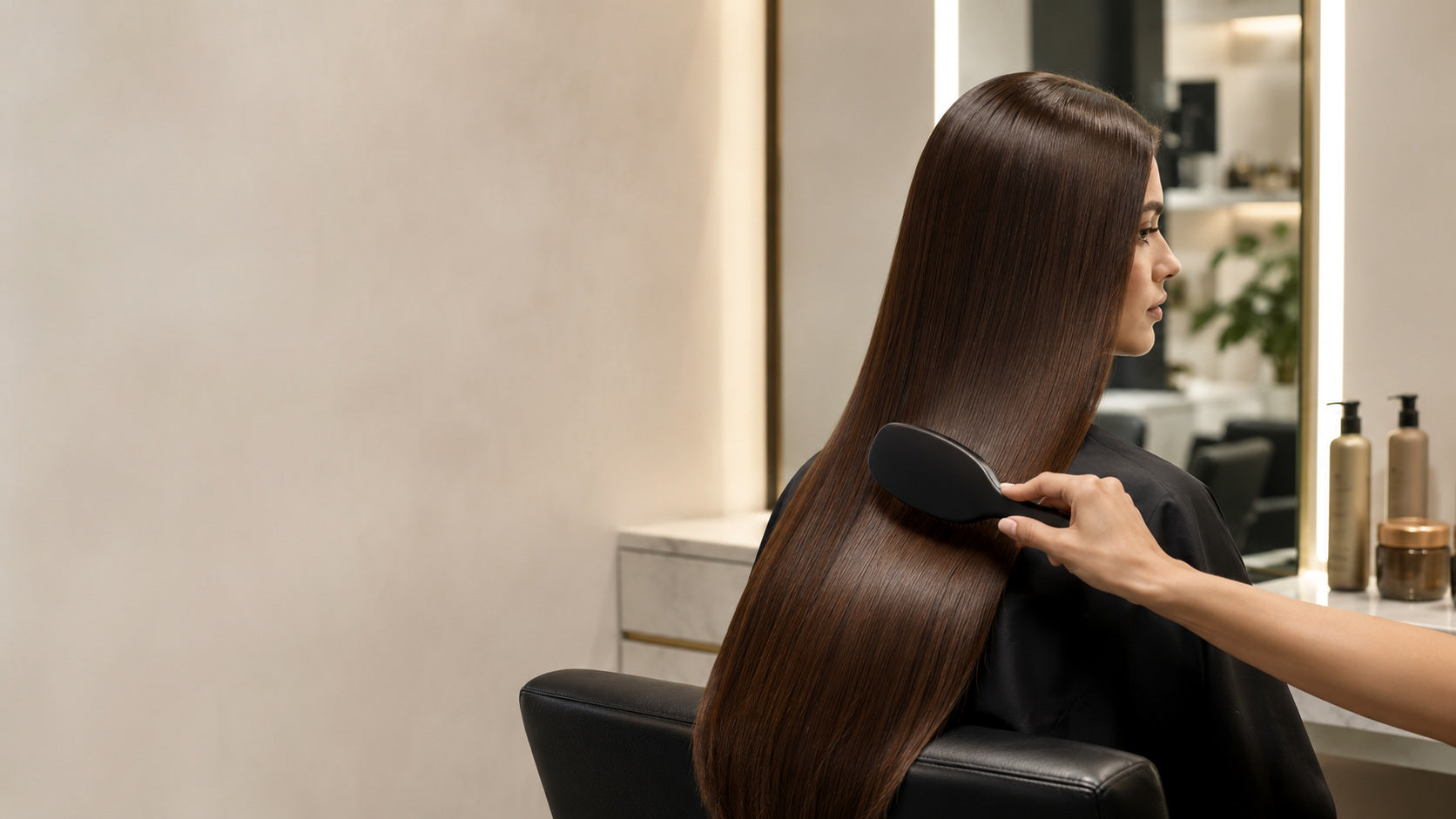
The way you brush your hair — the tool you use and the technique — determines how much breakage happens. This is especially true when hair is wet, tangled, or fragile. The Moyoko detangling brush is one of the tools Partners Hair consistently recommends for minimising mechanical damage during daily brushing and detangling.
Meet the experts:
Royston and Warren at Cavendish Square — Judy, head trainer — Lewis, owner — Jackie at Gardens Centre — Debbie and Nikí at V&A Waterfront — Danny and Charlene at Canal Walk — Lynette, Samantha and Dominique at Constantia Village
01 — Why Detangling Brushes Are Different
A standard paddle brush or bristle brush pushes through knots with rigid pins. Detangling brushes have flexible, soft-tipped pins that give way when they meet resistance and work around the knot rather than through it. This is the mechanism that reduces breakage — the brush doesn't force through the tangle, it works with it.
“The physics of detangling are simple,” says Judy, head trainer. “A rigid pin going through a knot exerts force on the hair from the outside in. A flexible pin that bends before the knot does distributes that force differently and reduces the number of strands that snap. For clients who brush daily, especially on curly or fragile hair, the tool makes a tangible difference to breakage over time.”
02 — The Right Technique: Bottom-Up Always
The tool matters, but so does the technique. Always detangle from the ends upward — not from the roots down. Start at the very ends with short strokes to remove the lowest knots, then work up the hair shaft section by section. By the time you reach the root area, the knots have already been removed from below and the brush moves through smoothly. Starting at the roots and dragging a knot down the full length of the hair causes the most breakage.
“Bottom-up detangling is the single most impactful technique change most people can make,” says Warren at Cavendish. “It's not complicated. Start at the ends. Remove those knots. Move up 5cm. Remove those knots. Repeat. By the time you're at the roots, there's nothing left to fight through.”
03 — The Moyoko Range
The Moyoko detangling brush comes in five colours (black, orange, pink, purple, turquoise) and uses argan oil-infused pins — which means a light conditioning effect is distributed through the hair as you brush. The rounded design fits the contour of the head, making brushing more comfortable with less wrist fatigue.
Available in the original and a travel-friendly compact size — both with the same flexible pin design.
- Moyoko Detangling Brush — Black
- Moyoko Detangling Brush — Orange
- Moyoko Detangling Brush — Pink
- Moyoko Detangling Brush — Purple
- Moyoko Detangling Brush — Turquoise
04 — When Detangling Matters Most
On wet hair — the highest-risk moment. Wet hair has less structural integrity and is significantly more prone to breakage under tension. Never brush wet hair with a rigid bristle brush. A detangling brush or a wide-tooth comb is essential at this stage. On naturally curly or coily hair — the curl pattern creates more knots and the detangling process is longer, which means more cumulative force on each strand. A flexible-pin brush reduces the damage throughout this process. On fragile, fine, or chemically processed hair — all of these have reduced structural integrity. Gentler tools and techniques directly reduce breakage.
05 — Supporting the Detangling Process
A leave-in conditioner or detangling spray applied to damp hair before detangling reduces friction and makes the brush move through hair more smoothly. This is particularly important for curly, textured, or very dry hair where dry detangling causes significantly more breakage than damp detangling. The Moyoko's argan oil-infused pins provide some of this friction reduction — but a leave-in product on the hair first gives the most protection.
“On curly or textured hair, always detangle on damp hair with a leave-in applied first,” says Samantha at Constantia. “The leave-in reduces friction. The detangling brush reduces force. Both together give the gentlest possible result. Dry detangling on textured hair without a leave-in is the combination that causes the most preventable breakage.”
06 — A Good Brush Is a Long-Term Investment
A professional-grade detangling brush maintained correctly (clean it regularly, remove accumulated hair and product buildup) will last years. The daily reduction in mechanical breakage — compounded over months and years of brushing — makes a visible difference to hair density and condition over time. It's one of the lower-cost hair care investments with one of the most consistent returns.
Frequently Asked Questions
Is a detangling brush better than a wide-tooth comb?
For wet, curly, or tangled hair, both are significantly better than a standard brush. A detangling brush covers more area per stroke. A wide-tooth comb gives more precision on specific knots. Many people use both — wide-tooth comb first to remove major knots, detangling brush second to smooth through.
Can I use a detangling brush on wet hair?
Yes — that's one of its primary use cases. It's specifically designed to handle wet hair more gently than a rigid bristle brush. Apply a leave-in or detangling spray first for best results.
Does the Moyoko brush work on natural hair?
Yes — the flexible pin design is particularly well-suited to natural, curly, and coily hair where standard brushes cause the most damage. Always detangle from ends to roots, on damp hair with a leave-in applied.
How do I clean a detangling brush?
Remove accumulated hair after each use. Once a week, rinse the brush under warm water with a small amount of shampoo to remove product buildup, then leave to air dry.
Where can I buy Moyoko detangling brushes in South Africa?
Partners Hair stocks the full Moyoko detangling brush range online and in our Cape Town salons. Free delivery on orders over R390.
Shop Moyoko detangling brushes at Partners Hair, or find your nearest salon. Free delivery on orders over R390.
Exploring the rest of the range? Read the complete Moyoko styling tools guide — straighteners, dryers, curlers and brushes in one place.
Share:
Pureology Colour Fanatic: The Ultimate Leave-In Spray for Vibrant Hair
Revive Your Curls with L’Oréal Curl Expression