



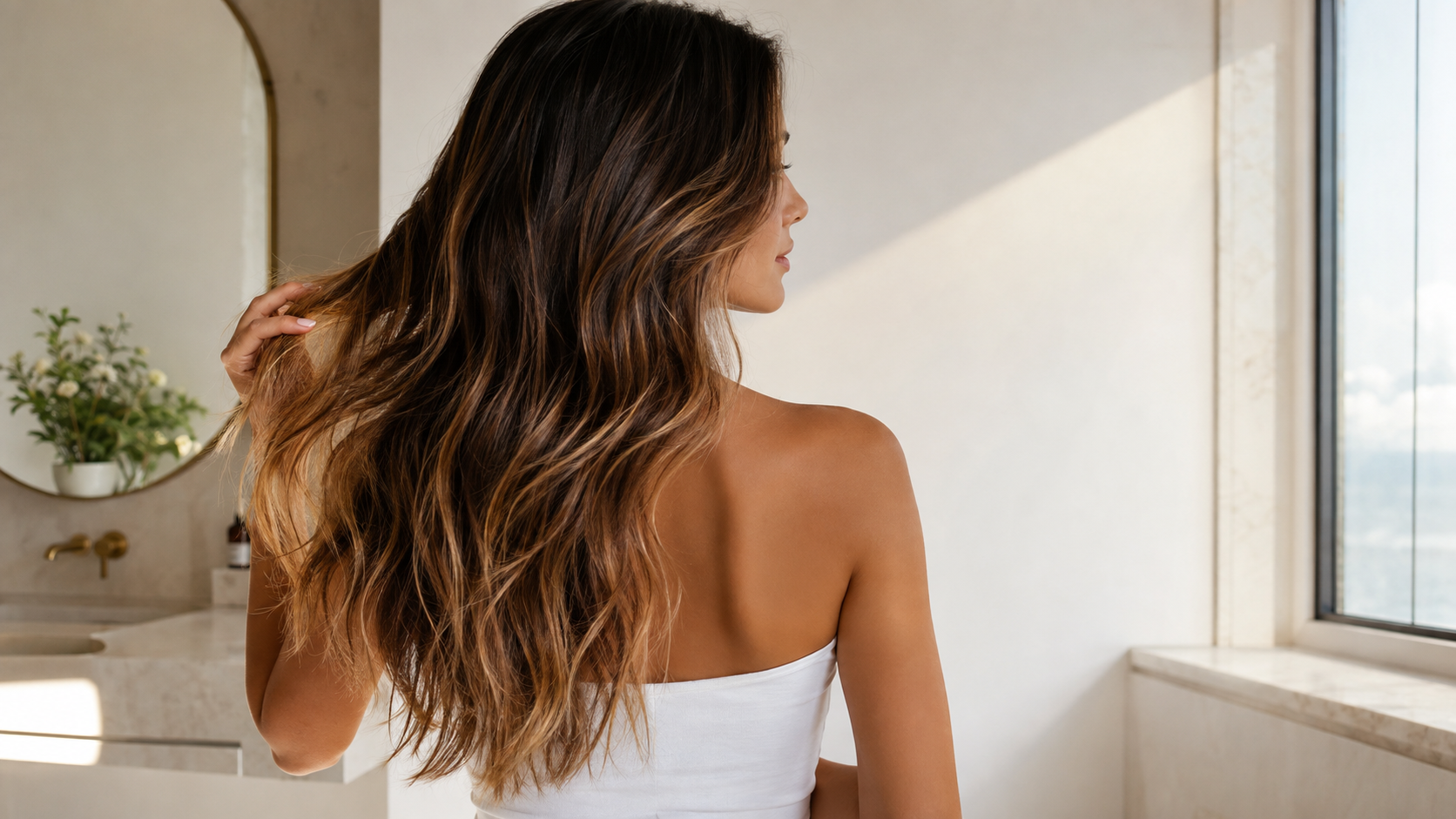
Colour fade feels random — one client's balayage looks fresh at week ten, another's is flat by week three. It is not random. Fade has five causes, they are all measurable, and once you know which ones apply to your hair, the fixes rank themselves. This is the science behind every recommendation in our complete colour care guide.
Where colour actually lives.
Permanent colour works by opening the cuticle — the shingle-like outer layer of each strand — and forming pigment molecules inside the cortex beneath it. Once developed, those molecules are too large to simply fall out. Fade is the process of them escaping anyway, and everything that fades colour does it one of two ways: lifting the cuticle so pigment can leak, or chemically breaking the pigment down in place.
The five causes, ranked.
1. Water. The unglamorous truth: plain water causes most fade. Hair swells when wet, the cuticle lifts, and dissolved pigment escapes with every rinse — hotter water, wider open, faster loss. This is why wash frequency beats every product choice: a colour washed daily receives triple the fade events of one washed twice a week.
2. Surfactants. Strong sulphate detergents are excellent at removing oil — and nearly as good at escorting pigment out of swollen hair. Gentler sulphate-free surfactants clean with less pigment loss; the sulphate-free guide covers the chemistry, and everything in the Colour Treated Hair collection is formulated on this principle.
3. Heat. Irons and hot dryers do double damage — they degrade pigment molecules directly and roughen the cuticle so the next wash strips more. Every degree over necessary costs colour; heat protection and moderate temperatures are colour-care products in disguise.
4. UV. Sunlight breaks down pigment through oxidation — the same reason curtains fade. In South African summer UV, uncovered colour fades measurably faster and shifts warmer; a UV-filtering leave-in or a hat is the fix. Chlorine compounds the problem in pool season, oxidising pigment and depositing green-grey mineral tints on light hair.
5. Porosity. Damaged, previously-lightened hair is porous — the cuticle no longer seals. Porous hair grabs colour fast in the chair and releases it just as fast at home, which is why the mid-lengths of long, repeatedly-coloured hair fade first. Porosity is the one cause you repair rather than avoid: bond builders rebuild internal structure, weekly masks smooth and seal the cuticle, and acidic glosses — explained in toner vs gloss — clamp it flat.
Fade vs tone shift.
Two different failures get called “fade”. True fade is pigment leaving — colour goes lighter and flatter. Tone shift is warm underlying pigment showing through as cooler dye components exit first — blonde goes yellow, brunette goes red-orange, red goes orange. Fade wants pigment replaced (depositing care, gloss, salon refresh); tone shift wants neutralising (purple shampoo for blonde, blue-pigmented care for brunette — start with the brass guide). Diagnose which you have before buying anything.
The fixes, ranked by colour saved.
In order of impact: halve your wash frequency; switch to cool water and sulphate-free formulas; protect from heat and cap iron temperatures; add UV protection in summer; mask weekly and bond-build if lightened; gloss monthly. Do the first three and most people double their colour's lifespan before spending anything on step four. Every product built for the job — 300-plus of them — lives in the Colour Fade collection.
FAQs.
Does cold water really keep hair colour longer?
Cooler water, yes — it keeps the cuticle flatter during washing so less pigment escapes. It is one lever among several, not magic: cool water with daily washing still loses to warm water twice a week.
How much does hard water affect colour?
Mineral-heavy water deposits calcium and copper on the hair, dulling colour and pushing blonde brassy or green over time. A chelating or clarifying wash monthly strips the build-up; parts of SA on borehole or mineral-rich supply notice this most.
Why does the ends of my hair fade faster than the roots?
Porosity. Your ends are the oldest, most-processed hair on your head — the cuticle seals worst there, so pigment leaves fastest. Masks, bond builders and glosses concentrated on mid-lengths and ends close the gap.
Do colour-protecting shampoos actually work?
Yes, for a specific reason: they swap aggressive surfactants for gentler ones, so each wash removes less pigment. They slow fade rather than stop it — wash frequency and temperature still matter more than any single product.
Partners Hair — 24 Cape Town salons since 1984. Authorised stockists, free delivery over R390.
Share:
Red Hair Colour Care: How to Stop Red Fading So Fast
The Overnight Routine for Curly Hair: How to Wake Up With Defined Curls