



Expert guidance from the Partners Hair salon team · September 2026
If your roots look greasy within a day of washing while your lengths still feel clean — or even dry — the problem is usually the scalp routine, not the whole head of hair. The goal is not to strip every trace of oil away. It is to keep the scalp comfortably clean, remove build-up properly and treat the lengths separately.
Key takeaways
- An oily scalp produces more sebum than your hair needs, but product build-up, sweat and an unsuitable routine can make it look even oilier.
- Wash as often as your scalp genuinely needs. There is no prize for stretching an oily scalp to day four.
- Shampoo belongs mainly on the scalp; conditioner, masks and oils belong mainly on the mid-lengths and ends.
- Oily roots with dry ends are extremely common and need a split routine rather than one product for the entire head.
- Dry shampoo is useful between washes, but repeated layering can add build-up.
- Persistent oiliness with redness, itching, scaling or soreness is worth assessing rather than simply buying a stronger shampoo.
Why does my scalp get oily so quickly?
Sebum is the scalp's natural oil. It protects the skin and helps lubricate the hair, so oil itself is not the enemy. How quickly the roots look greasy varies with genetics, hormones, hair density, exercise, climate, styling habits and how much product reaches the scalp.
Fine hair often appears oily sooner because even a small amount of sebum is visible across lightweight strands. Heavy conditioner at the roots, leave-in creams, oils, dry shampoo and styling residue can also create the appearance of an excessively oily scalp when part of the problem is actually build-up.
Is it oil or product build-up?
Mostly oil: the roots become shiny, separated and flat fairly predictably after washing, even when you use very little styling product.
Mostly build-up: the hair can feel coated, dull or strangely heavy; shampoo may not lather easily on the first cleanse; and the problem often becomes worse after repeated dry shampoo, oils or styling products.
Many clients have both. A sensible routine deals with the daily oil without letting residue accumulate.
Should you wash oily hair every day?
Wash according to the scalp, not a rule from social media. If your scalp is genuinely oily and uncomfortable after a day, daily or every-second-day cleansing with an appropriate shampoo can make more sense than forcing yourself to stretch washes.
What matters is technique. Wet thoroughly, apply shampoo to the scalp rather than coating the lengths, massage gently with fingertips and rinse properly. If there is significant product or dry-shampoo build-up, two light shampoos can cleanse more evenly than one aggressive scrub.
Very hot water and vigorous scratching are unnecessary. A clean scalp should feel comfortable, not squeaky or irritated.
Oily roots but dry ends?
This is one of the most common combinations we see, particularly on longer, highlighted, coloured or heat-styled hair. Your scalp is living skin producing oil; your ends are older hair fibre that may need moisture and protection. They do not have to be treated with the same product.
Cleanse the scalp according to its needs, then condition only from the mid-lengths downward. Masks, oils and richer leave-ins can be concentrated on the driest areas without putting them on the roots.
For the full routine, read dry ends and oily roots: what should you use?
What should you change first?
- Move conditioner down. Keep it away from the scalp unless the formula specifically says otherwise.
- Use less styling product at the roots. Oils and rich creams are particularly easy to overdo.
- Clean your brush. Oil and styling residue on brushes can go straight back onto clean hair.
- Stop stacking dry shampoo for days. Use it strategically, then wash it out properly.
- Choose shampoo for the scalp. Let conditioner and treatment products solve the needs of the lengths.
Which professional products do we recommend for an oily scalp?
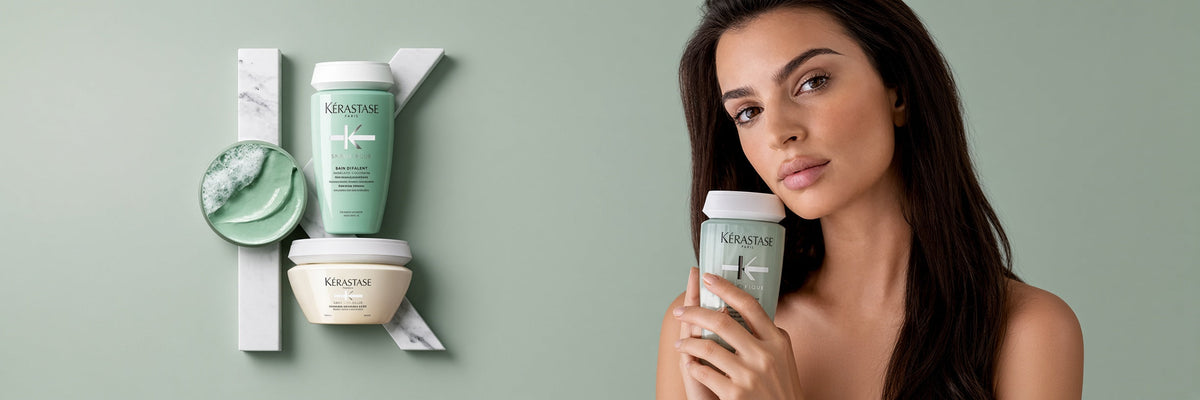
Kérastase has several useful scalp-focused options. Browse our Kérastase for Oily Scalp collection. If oiliness is accompanied by visible dandruff, Kérastase Symbiose Bain Pureté Anti-Pelliculaire is designed for an oily scalp with dandruff.
Kérastase Spécifique Potentialiste Scalp Serum can be considered when you are building a broader scalp-care routine. For a more accessible cleansing option, muk Head Muk Oily Scalp Shampoo is another targeted choice.
The right product depends on whether the main issue is simply oil, oil plus build-up, dandruff, sensitivity or dry lengths alongside oily roots. Browse the full scalp-care collection.
Does Cape Town weather make oily hair worse?
It can change how quickly hair feels dirty. Warm days, exercise and perspiration can make roots collapse sooner, while wind and sun can leave the lengths feeling drier at the same time. That combination is another reason not to treat oily roots and dry ends as one problem.
If you swim regularly, wear hats often or use a lot of styling product, build-up can become part of the picture too. An occasional thorough cleanse may be useful, but it should not leave the scalp irritated.
When is an oily scalp more than an oily scalp?
If oiliness comes with persistent itching, redness, thick scale, sores, marked tenderness or sudden changes, do not keep escalating to harsher shampoos. A stylist can help identify product build-up and routine problems, but persistent scalp symptoms may need assessment by a healthcare professional or dermatologist.
One of the most useful things we can do in the salon is look at the scalp and the lengths separately. Someone can have oily roots and genuinely dry, colour-treated ends at exactly the same time — the routine has to respect both. — Partners Hair salon team
Not sure what your scalp actually needs?
Bring the products you currently use or tell us your routine. A Partners Hair stylist can help distinguish between oil, product build-up, dry lengths and common scalp concerns, then simplify the routine around what your hair actually needs.
Ask the Experts · Find your nearest Partners Hair salon · Shop scalp care
Frequently asked questions
Why is my hair greasy the day after washing?
Your scalp may naturally produce oil quickly, particularly if your hair is fine. Sweat, heavy root products and build-up can make it appear greasy even sooner. Start by simplifying what touches the scalp and washing according to how oily it actually becomes.
Does washing every day make oily hair worse?
Not automatically. An oily scalp can be washed daily if necessary with a suitable formula and gentle technique. The bigger problems are irritation, aggressive scrubbing and using products that leave the scalp uncomfortable.
Can I train my hair to become less oily?
Stretching washes does not reliably change your genetic or hormonal sebum production. Some people find their routine becomes easier after reducing heavy products or harsh cleansing, but you do not need to tolerate an uncomfortable scalp in order to 'train' it.
Can dry shampoo fix oily hair?
Dry shampoo absorbs some surface oil and can extend a style, but it does not cleanse the scalp. Repeated layers can contribute to build-up. Read our dry shampoo guide.
Why are my roots oily but my ends dry?
The scalp produces sebum while the ends are older hair fibre exposed to washing, colouring, heat and the environment. Shampoo the scalp and condition the lengths instead of trying to find one formula that treats both identically.
Can dandruff happen on an oily scalp?
Yes. Dandruff can occur on an oily scalp. If you have visible flakes as well as oiliness, see our dandruff shampoo guide and consider a targeted anti-dandruff routine.
Part of our complete Scalp Health guide. Continue with oily roots and dry ends, or explore professional scalp care.
Advice from salon-trained professionals. Partners Hair — 24 salons across Cape Town, serving clients since 1984.
Share:
Redken All Soft Conditioner: Why Dry Hair Feels Different After One Wash