


Reviewed by Royston, Premier Stylist & Trainer, Partners Hair Cavendish Square · September 2026
A blowbrush does one thing a dryer and round brush can't: it puts the heat and the tension in the same hand. That's why the Magnitude sells, and it's also why it disappoints people who buy it for the wrong hair. Here's who it's for, who should keep their dryer, and the technique that makes the difference.
Key takeaways
- A blowbrush combines airflow and tension in one tool, so you get a smooth, voluminous finish one-handed.
- Best on fine to medium hair, chin-length or longer. It's the fastest route to a bouncy blow-dry for that hair.
- Rough-dry to about 70% first. Using it on soaking-wet hair is the number-one mistake.
- Not the tool for tight curls you want to keep defined, or for very thick, coarse hair — a dryer and round brush still win there.
- Heat protection every time, and keep it moving. It's a hot tool, not a hairbrush.
What does a blowbrush actually do?
A conventional blow-dry needs two hands: one holding the dryer, one pulling the hair taut over a round brush. The tension is what smooths the cuticle and sets the shape; the airflow dries it in that shape. A blowbrush like the Magnitude puts the hot air inside the brush barrel, so one hand does both jobs. The result is a smooth, lifted finish that most people can't get at home with a separate dryer and brush — not because they can't do it, but because they can't do it with one hand while the other one holds a phone.

Who is it for?
Fine to medium hair, chin-length or longer, that wants smoothness and volume. Straight-to-wavy textures. Anyone who wants a blow-dry look without the coordination. If that's you, it's the best tool in the category for the money.
Who should keep their dryer: tight curls you want to keep curly — a blowbrush smooths, which is the opposite of what you want. Very thick or coarse hair, where the barrel can't move enough air to dry it efficiently and you'll end up going over sections again and again. Very short hair, which needs a small round brush the barrel can't replace.
The technique that makes it work
- Rough-dry first. Towel, then dryer or air, until the hair is about 70% dry. The blowbrush finishes; it doesn't start.
- Heat protection on damp hair, combed through.
- Section. Clip the top up and work from the nape forward in sections no wider than the brush.
- Roots first. Place the brush under the section at the root, lift, and hold for a second before drawing down. That's where the volume comes from.
- Draw slowly to the ends with the hair taut, turning the brush under for a curve or straight for sleek.
- Cool shot on each section if the tool has one — it sets the shape.
- Finish with a light serum on the ends. No hairspray until it's completely cool.
Blowbrush vs dryer and round brush vs Pro Glider
Dryer and round brush — most control, best on thick hair, needs two hands and practice.
Blowbrush — one-handed volume and smoothness on fine to medium hair. Less control, more speed.
Pro Glider straightener — sleek and flat, not lifted. Different finish entirely; many people own both.
For the longer comparison, see hot-air brush vs dryer.
Which Magnitude should I buy?
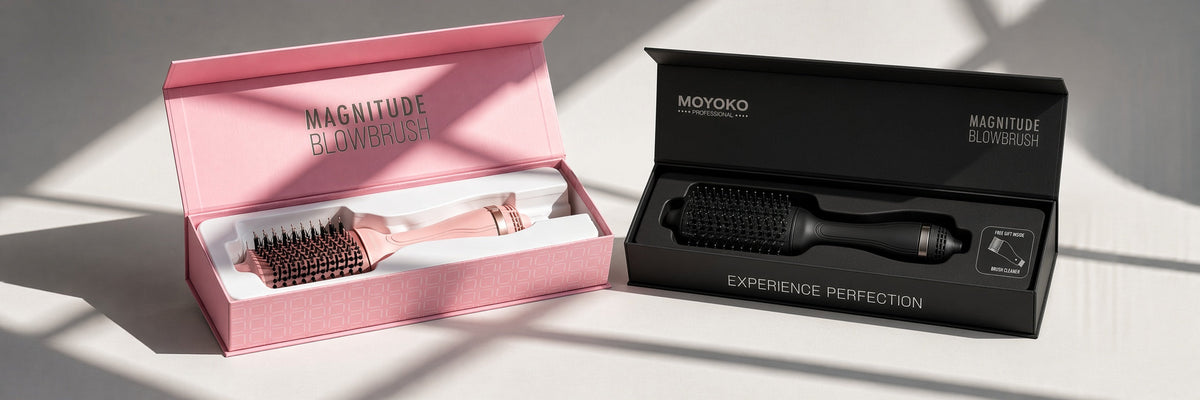
- Magnitude 2-in-1 Hot Air Brush — Black — the full-size barrel for chin-length and longer hair.
- Magnitude 2-in-1 Hot Air Brush — Pink — same tool, same barrel, in pink.
- MINI Magnitude — Black and MINI Magnitude — Pink — the smaller barrel for shorter hair, fringes and travel.


The Cape Town factor
Humidity is the enemy of a blow-dry, and the South-Easter is worse. The blowbrush finish holds up if the hair is fully dry — any dampness left in the lengths is what frizzes by lunchtime. Take the extra minute on the ends, and use an anti-humidity finishing spray in summer.
'I teach the blowbrush to every junior who comes through the Academy, and the lesson is the same one I give clients: it's a finishing tool. Rough-dry to seventy percent, section, roots up, and it'll give you a salon finish in ten minutes. Put it on wet hair and you'll be there for forty and blame the brush.' — Royston, Premier Stylist & Trainer, Partners Hair Cavendish Square

Personal consultations with Royston. Fine hair that won't hold volume, or thick hair that takes forever to dry? Book a one-on-one with Royston at our Cavendish Square salon.
Book a styling lesson · Shop Moyoko
Frequently asked questions
Can I use the Magnitude on wet hair?
Rough-dry to about 70% first. On wet hair it's slow and the finish doesn't hold.
Is it good for curly hair?
For smoothing curls out, yes. For keeping them defined, no — use a diffuser.
Blowbrush or straightener?
Different finishes. A blowbrush lifts and smooths; a straightener flattens and sleeks. They're not substitutes.
Do I still need heat protection?
Yes, every time. It's a hot tool.
How long does a full blow-dry take?
On fine to medium shoulder-length hair, about ten minutes after rough-drying. Thick hair takes longer and may be faster with a dryer.
Advice from salon-trained professionals. Partners Hair — 24 salons across Cape Town, since 1984.
Share:
Moyoko: The Complete Guide to Moyoko Styling Tools in South Africa