



TL;DR:
- Olaplex repairs the disulfide bonds inside the hair shaft that break during bleaching, colouring, and chemical processing — no other product category did this before 2014
- The 9-step numbering system is the brand's biggest source of confusion — Nos. 1 and 2 are salon-only, Nos. 0 through 9 are at-home, and not all of them are necessary for every routine
- Most people only need 3-4 products: a weekly No.3 treatment, the No.4 and No.5 shampoo and conditioner, and the No.6 Bond Smoother for styling
- Counterfeit Olaplex is widespread in South Africa — only buy from authorised stockists
- Olaplex works particularly well in Cape Town's humid coastal climate, where colour and frizz are constant battles
If your hair has been bleached, coloured, relaxed, permed, or fried by heat tools, there's a good chance Olaplex has come up in conversation — usually as the brand that "fixes" damaged hair. But the 9-step numbering system, the salon-versus-home distinction, the No.4P versus No.4C question, and the constant counterfeit warnings have made it confusing for most people to know where to start. This guide cuts through the confusion.
Meet the experts:
Royston and Warren at Cavendish Square — Judy, head trainer — Lewis, owner — Jackie at Gardens Centre — Debbie and Nikí at V&A Waterfront — Danny and Charlene at Canal Walk — Lynette, Samantha and Dominique at Constantia Village
01 — What Olaplex Is (and How It Actually Works)
Hair is made of keratin protein, and that protein is held together by chemical bonds — primarily disulfide bonds — that give your hair its structure and strength. When you bleach, colour, perm, or relax your hair, the chemical process breaks some of those disulfide bonds. The same thing happens with extreme heat damage over time. Once broken, those bonds don't reform on their own.
Olaplex was founded in California in 2014 by Dean Christal, with chemists Dr Eric Pressly and Dr Craig Hawker developing the patented active ingredient: bis-aminopropyl diglycol dimaleate. That single molecule does something no professional hair care product had ever done before — it reaches into the cortex of the hair shaft and physically reconnects the broken disulfide bonds.
"This is the part most people miss," says Lewis. "Olaplex doesn't condition your hair. It doesn't add moisture. It doesn't coat the surface. It actually rebuilds the broken internal bonds that chemical processing damages. That's why it's so effective for clients with badly bleached or processed hair — and why it can feel like it's not doing much on hair that isn't damaged."
The result: stronger hair, less breakage, better colour retention, and a noticeable difference in how the hair behaves after chemical services.
02 — The Olaplex Numbering System Explained
The confusion around Olaplex usually starts with the numbering. There are products labelled No.0 through No.9 — but not in order, not all available at home, and not all necessary for every routine. Here's how the system actually works:
- No.1 and No.2 — Salon-only. Used by professional colourists during and after colour and bleach services to prevent and repair bond damage at the moment chemical processing happens.
- No.0 — At-home. A pre-treatment primer used before No.3 for severely damaged hair.
- No.3 — The iconic at-home Hair Perfector. The most-recommended Olaplex product globally.
- No.4 and No.5 — At-home shampoo and conditioner. Daily bond maintenance.
- No.4P — Purple toning shampoo for blondes (combines bond maintenance with brassiness control).
- No.4C — Clarifying shampoo for buildup, hard water, and pre-treatment prep.
- No.6, No.7, No.8, No.9 — Leave-in styling and finishing products.
"You don't need all of them," says Judy, head trainer. "Most clients do best with No.3 weekly, No.4 and No.5 for everyday washing, and No.6 for styling. The rest are useful add-ons depending on your hair type and concerns."
03 — Every Olaplex Product, Explained
No.0 Intensive Bond Building Hair Treatment
A pre-treatment used before No.3 for hair that's severely damaged or heavily bleached. Sprayed onto dry hair, left for 10 minutes, then layered with No.3 for another 10-20 minutes before washing out. Most clients don't need No.0 — it's specifically for hair that needs maximum repair.

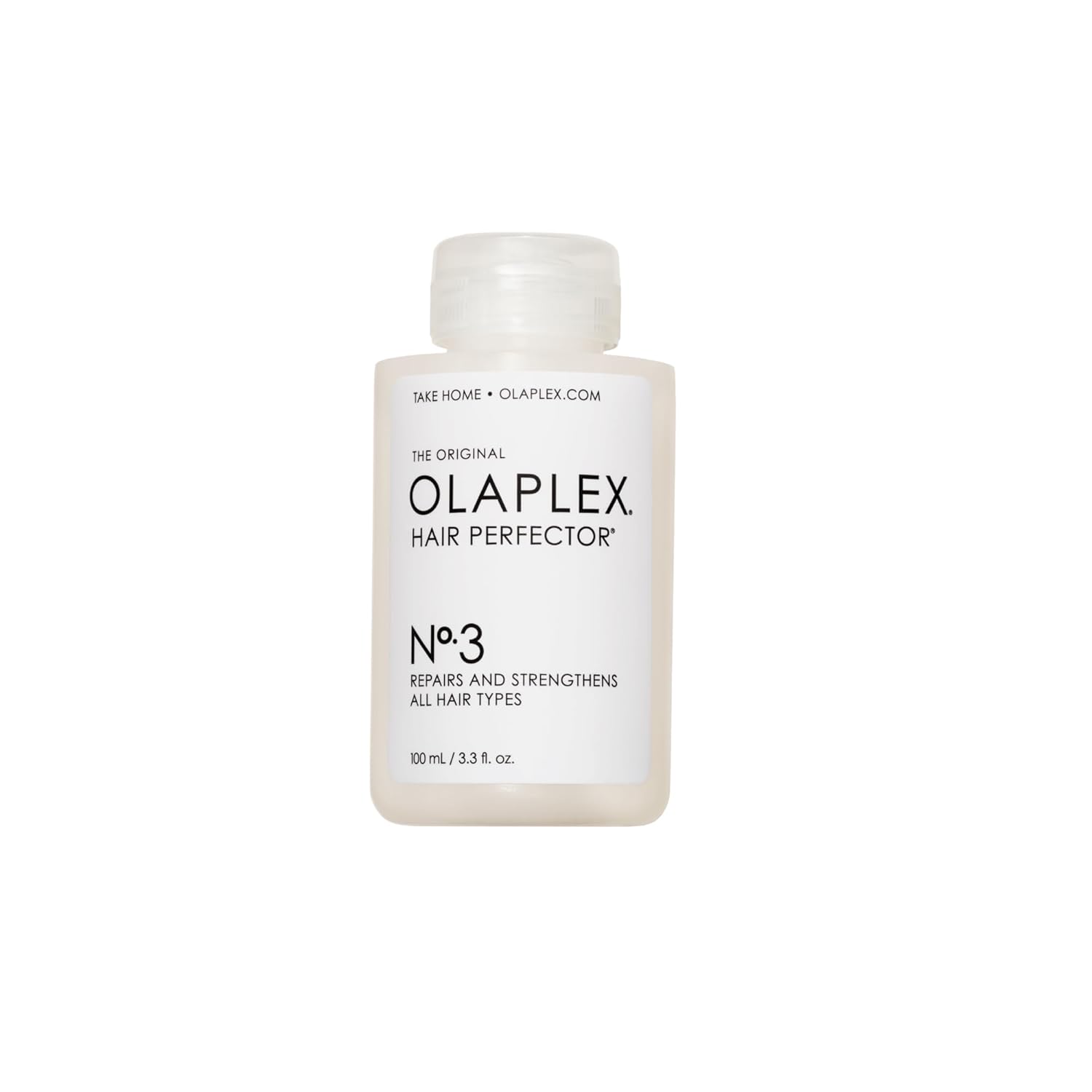
No.3 Hair Perfector
The most iconic at-home Olaplex product, and the most recommended starting point. Applied to damp hair, combed through, left for 10 minutes (or longer), then washed out with shampoo and conditioner. Used weekly for damaged or chemically processed hair, fortnightly for maintenance. The single product most people start with.

No.4 Bond Maintenance Shampoo
A sulfate-free shampoo that gently cleanses while continuing the bond-building process during every wash. Suitable for all hair types, particularly recommended for colour-treated, bleached, and chemically processed hair. Pairs with No.5.

No.4P Blonde Enhancer Toning Shampoo
A purple-pigmented bond-building shampoo. Neutralises yellow and brassy tones in blonde, highlighted, and grey hair while also repairing bonds. A two-in-one for blondes — replaces both your purple shampoo and your regular shampoo.

No.4C Bond Maintenance Clarifying Shampoo
A clarifying shampoo with bond-building benefits. Removes hard water mineral buildup, chlorine, product residue, and pollutants from the hair without the harsh stripping effect of most clarifying shampoos. Particularly relevant in South Africa where hard water is widespread.

No.5 Bond Maintenance Conditioner
The matching conditioner for No.4. Lightweight, hydrating, and continues the bond-building process. Detangles well and is suitable for daily use across most hair types.

No.6 Bond Smoother
A leave-in styling cream applied to damp hair before blow-drying. Smooths the cuticle, controls frizz, and continues bond repair while you style. One of the most popular Olaplex products for clients in Cape Town's humid climate.

No.7 Bonding Oil
A lightweight, concentrated bonding oil. Provides heat protection up to 230°C (450°F), adds shine, and reduces frizz. Applied to damp or dry hair, ends-focused. Doesn't weigh hair down — suitable for fine hair where most oils are too heavy.

No.8 Bond Intense Moisture Mask
A weekly intensive moisture treatment that also continues the bond-repair process. Used in place of regular conditioner once a week (typically Sunday wash day). Adds dramatic shine, moisture, and softness — particularly effective for dry, damaged hair.

No.9 Bond Protector Nourishing Hair Serum
A lightweight leave-in serum that protects against environmental damage — UV, pollution, and free radicals — while continuing bond protection. Applied daily to damp or dry hair.

04 — How to Build an Olaplex Routine at Home
The Olaplex range is comprehensive enough to overwhelm any beginner. Most people don't need to buy everything. Here's how to build a routine based on your hair situation:
Starter routine (most clients): No.3 weekly + No.4 and No.5 for everyday washing. That's it. This covers the majority of clients who want to maintain coloured hair, repair light damage, and improve hair strength over time.
For severely damaged or bleached hair: Add No.0 before No.3 once a week. Layer No.6 onto damp hair before blow-drying for daily smoothness and continued repair. Add No.8 as a weekly mask in place of No.5 conditioner for maximum moisture.
For blondes: Replace No.4 with No.4P twice a week to maintain colour neutrality. Use regular No.4 for the other washes. The combination prevents over-toning while still maintaining the bond-building benefit on every wash.
For frizz-prone hair (especially in Cape Town): Add No.6 before every blow-dry, and finish with No.7 Bonding Oil for shine and humidity control. The two together create a humidity barrier that lasts longer than either alone.
"Don't overcomplicate it," says Charlene at Canal Walk. "Most clients arrive thinking they need every Olaplex product. They don't. Start with No.3, No.4, No.5 — use them consistently for six weeks — and see what your hair actually needs from there."
05 — Olaplex for Bleached, Colour-Treated and Frizzy Hair
Olaplex's strongest benefit is for hair that has been chemically processed. The science is straightforward: chemical services break bonds; Olaplex rebuilds them. But there are differences in how to use the system depending on what your hair has been through.
For bleached hair: The most intensive Olaplex routine is justified here. No.3 weekly (or before every wash for the first six weeks after a heavy bleaching service), No.4 and No.5 as your everyday system, and No.6 or No.7 for styling protection. Some clients also layer No.0 before No.3 for maximum repair.
"Clients who come in for a major bleaching service — full balayage, total lift, platinum — get No.1 and No.2 from us in the salon as part of the treatment," says Warren at Cavendish. "Then we send them home with No.3 to use weekly. The two phases work together: salon-applied during chemical processing, at-home maintenance afterward. Without the at-home phase, the salon work doesn't last."
For colour-treated hair: No.4 and No.5 as your daily routine, No.3 weekly. The sulfate-free formulas protect colour from fading while the bond repair maintains hair integrity between colour services. Many of our colourists recommend No.4 over other professional shampoos specifically for this combination of colour-safety and bond repair.
For frizzy hair in Cape Town: Cape Town's coastal humidity is particularly hard on hair that's also been chemically processed. Rough cuticles and broken bonds make frizz dramatically worse. The Olaplex combination of No.4 + No.5 + No.6 (Bond Smoother) + No.7 (Bonding Oil) is one of the most effective routines we've used for Cape Town clients dealing with humidity-driven frizz, particularly after colour services.
06 — Olaplex with Brazilian Keratin Treatments
For clients combining colour services with Brazilian keratin treatments — which is common in Cape Town — there's an important question about how Olaplex fits in. The short answer: it works well in combination, but timing matters.
"Olaplex is bond-building. A keratin treatment is bond-relaxing — temporarily — to smooth the hair," says Debbie at the Waterfront. "Used at the right time, they complement each other. But you shouldn't use No.3 in the week before a keratin treatment, and you should wait until at least the second week after a keratin service before resuming No.3 use."
For aftercare between keratin treatments, sulfate-free shampoo is essential — and Olaplex No.4 fits the bill. The combination of bond maintenance + sulfate-free + colour-safe makes it one of the better choices for keratin-treated, colour-treated, or both. No.5 conditioner is similarly appropriate.
07 — The Olaplex Counterfeit Problem in South Africa
Olaplex is one of the most counterfeited professional hair care brands in the world, and South Africa is particularly affected. Fake Olaplex products are widely sold on social media platforms, online marketplaces, and even through some unauthorised retailers — typically at prices significantly below the authentic retail price.
Counterfeit Olaplex contains none of the patented active ingredient that actually does the bond-repair work. At best, it does nothing — at worst, fake formulations can cause scalp reactions, contact dermatitis, and additional hair damage. There have been documented cases of severe allergic reactions linked to counterfeit Olaplex in South Africa.
How to spot fake Olaplex:
- Price is significantly lower than authorised retailers (anything more than 20% below retail is suspicious)
- Seller is on a marketplace platform, social media, or an unfamiliar website
- Packaging looks slightly off — colour shading, font weight, label alignment
- The product itself smells different, has unusual consistency, or doesn't behave as expected
- The seller can't verify their authorised stockist status
Partners Hair is a verified, authorised Olaplex stockist in South Africa. Every product is sourced directly from the official South African distributor. You can verify our authorised stockist status on the Olaplex website. Shop authentic Olaplex here.
Frequently Asked Questions
What's the difference between Olaplex and a hair mask?
A regular hair mask conditions the surface of the hair — adds moisture, softness, and shine through ingredients that coat the strand. Olaplex works inside the hair shaft, repairing the chemical bonds that hold the structure of the hair together. They're complementary, not interchangeable. Most damaged hair needs both: bond repair (Olaplex) plus moisture (a hydrating mask).
How often should I use Olaplex No.3?
Weekly for damaged, bleached, or heavily chemically processed hair. Fortnightly for maintenance once your hair has recovered. For severely damaged hair in the early stages of repair, you can use it before every wash for the first four to six weeks, then reduce frequency.
Can I leave Olaplex No.3 on overnight?
Yes. Leaving No.3 on for an extended period — even overnight under a shower cap — delivers more intensive repair. Particularly recommended for clients with severely damaged or recently bleached hair. The standard 10-minute application is the minimum effective time, not the maximum.
What's the difference between Olaplex and K18?
Olaplex repairs disulfide bonds — the chemical bonds broken by colour and bleach. K18 uses a biomimetic peptide to reconnect broken keratin chains. They use different chemistry and work on different aspects of hair damage. Many stylists recommend using both: Olaplex for ongoing maintenance, K18 for intensive repair sessions. They're not direct competitors — they're complementary. Read our detailed Olaplex vs K18 comparison.
Is Olaplex safe for colour-treated hair?
Yes — Olaplex is specifically formulated to be safe for colour-treated hair. The sulfate-free formulas of No.4 and No.5 protect colour from fading, and the bond-building science actively helps colour adhere and last longer. Many professional colourists consider Olaplex essential for clients with maintained colour.
Where can I buy authentic Olaplex in South Africa?
Through authorised stockists only. Partners Hair is one of South Africa's largest authorised Olaplex retailers — both online and through our salons across Cape Town. You can verify our authorised stockist status on the Olaplex website.
How long does it take to see results from Olaplex?
Many clients see and feel a noticeable difference after a single use of No.3 — particularly hair that's badly damaged. For most clients, the cumulative effect builds over four to six weeks of consistent use. Full repair on severely damaged hair takes longer — typically eight to twelve weeks of regular use.
Is Olaplex worth the money?
For hair that's been chemically processed, yes. Olaplex is the only product category that genuinely repairs the bonds broken by bleaching and colouring — and for clients investing in colour services, the cost of maintaining that investment with Olaplex is significantly less than the cost of repeated colour corrections from chronic damage. For hair that isn't chemically processed and isn't particularly damaged, the benefit is smaller and a high-quality conditioner may serve you better.
Shop authentic Olaplex at Partners Hair, or find your nearest salon for personalised advice on which products suit your hair. Free delivery on orders over R390 across South Africa. Same-day dispatch on orders placed before 1pm weekdays.
Share:
Hair Gel vs Mousse vs Wax: What’s the Difference and Which Do You Need?
The Five-Minute Morning Routine for Men: A Barber's Version